








Korean Lash Lift: The Asian Evolution That Is Changing the Lash Lift

We often say that it takes time before we can truly trust something new entering the market. Some trends create a brief initial buzz and then disappear without leaving a trace, while others arrive more quietly, remain a topic of discussion, and — against all expectations — establish themselves over time. One thing, however, is certain: when we at InLei® decide to develop something, it is never a passing trend. It becomes a project that grows, evolves, and, above all, lasts.
The first time we heard about Korean lash lamination — or, as it is often called outside of Europe, the Korean lash lift — was at the beginning of 2023. Opinions were sharply divided. Many claimed it was just another short-lived trend and that some trainers were simply capitalising on the moment by selling courses, without actually using the technique consistently in salon practice.
After some initial research, we too set the idea aside. It remained on hold until almost the end of the year, when — partly as a joke and partly as a challenge — we began experimenting with the well-known powder used in Asian lamination. The first results were, admittedly, quite uncertain.
Then, in March 2025, everything changed. During a competition in Australia that we attended in person, we discovered that in that part of the world, Korean lash lamination has been widely used for years, going through cycles of great popularity followed by quieter phases. That was the moment we decided to return to the project seriously — this time with true conviction and determination.
What Is Korean Lamination / Korean Lash Lift?
Korean lamination differs significantly from the classic European protocol, both in the products used and in the final result. It is a technique born and developed primarily in Asian countries, where almond-shaped eyes require a different and more pronounced type of lift compared to European or Caucasian eyes.
So, what are the key characteristics of Asian lamination?
1. Use of Powder
The powder acts as a gelling agent and is mixed with the first and/or second perming solution. Not all powders are the same: some perform exceptionally well, others are too mild, while some are so strong that they make removal difficult or interfere with the uniformity of the curl during the treatment.
2. Use of Cysteamine
(Cysteamine is an alternative to the more commonly used active ingredient, ammonium thioglycolate. Both function as reducing agents during the phase in which the hair’s shape is modified.)
It is often claimed that the first solution used in lash lamination should contain cysteamine, as it is considered more delicate during the physico-chemical process that allows the lashes to change curvature.
3. “L-Shaped” Curl or a Strong Root Lift
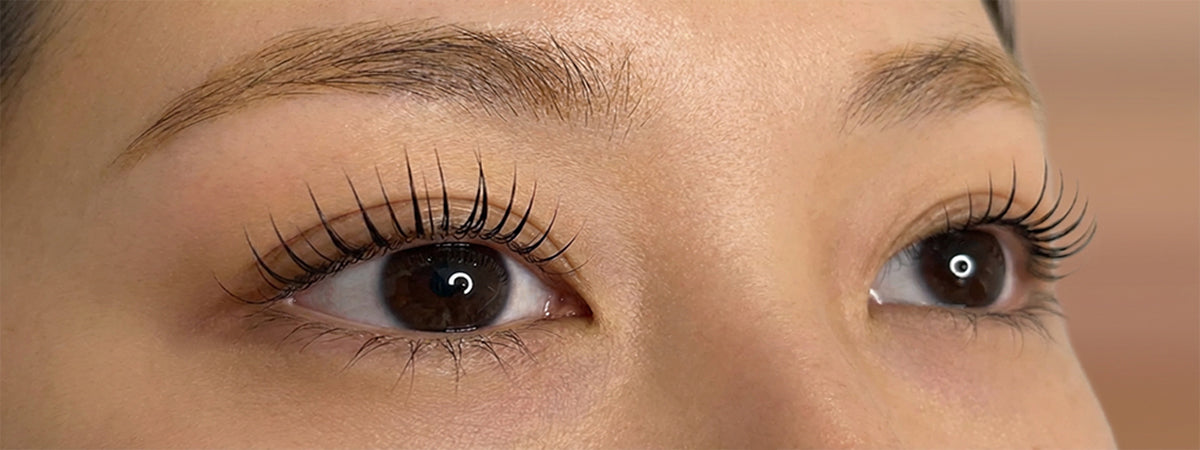
In our opinion, this is the most distinctive feature of Korean lash lamination. The effect creates an “L-shaped” bend at the root area, or at least a curl that is significantly more pronounced than the European standard.

Korean Lamination on a European Eye Structure
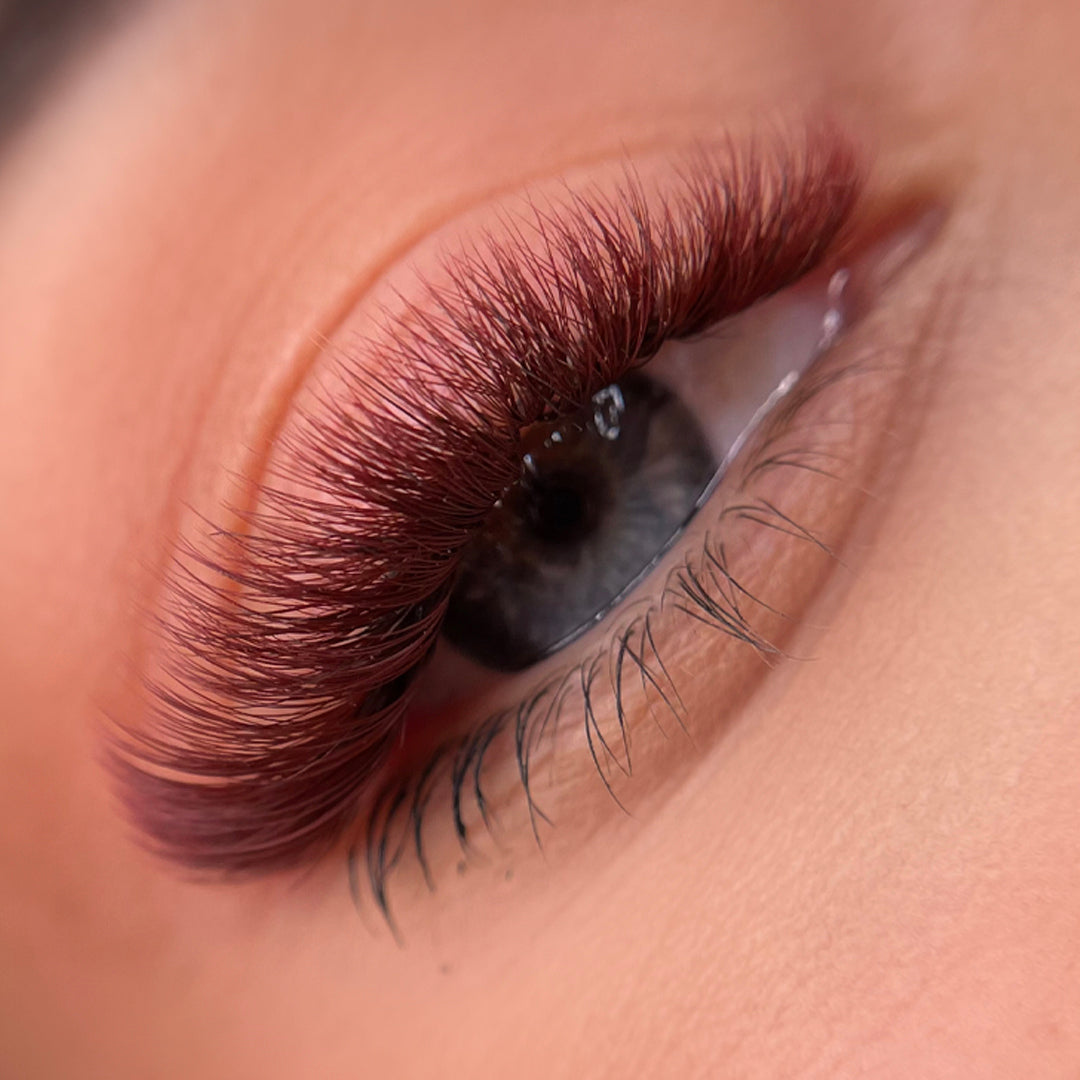
Below, you can see both the results we observed using the authentic Korean technique and the regrowth after 1–2 months.

Regrowth result of Korean lash lift.
How the “Classic” European Protocol Differs
Compared to the Korean method, the Classical lamination protocol differs in several keyways:
-
The solutions used
The classic water-soluble gel glue is no longer used, as the lashes are not pre-positioned on the shield. -
The final effect, which changes dramatically
While it may be ideal for Asian eyes, it can appear less harmonious on European eye shapes. - The execution, which is often described as faster.
In the example shown next to this section, Asian lamination is performed directly on an almond-shaped eye. In this case, the technique makes perfect sense: where the orbital cavity is less pronounced, the result dramatically opens the gaze, softens the epicanthus, and creates a wider, more harmonious appearance.
However, when applied to European or Caucasian eyes, the approach needs reconsideration. The method can be intelligently reworked and adapted both to product safety requirements and to a final result better suited to the eye structures we encounter daily in salons.

The Korean Lamination Protocol: What Changes Compared to the Classic Technique
After closely observing the technique, studying various interpretations, and understanding the logic behind the Korean lash lift, we decided to reproduce every step in our laboratories. It was essential to analyse not only the final outcome, but especially the behaviour of the lash during each phase, as Korean lamination follows a dynamic very different from that of the European technique.
For this reason, during our InLei® tests, we chose to use an experimental gelling powder formulated in-house. This allowed us full control over the reactions and enabled precise evaluation of every step. It’s important to note that when using products from other brands, quantities, ratios, and timings may need to be adjusted, as performance depends heavily on the specific formulation.
Let’s now look at what emerged from our testing and how the Korean lamination protocol develops step by step.
Initial Mixture and Application of the Korean Lash Lift
The first difference from the classic protocol concerns the use of the first solution. In our case, InLei® Form 1 is mixed with 10% powder.
The mixture is applied along the entire length of the lashes, maintaining approximately 1 mm distance from the roots, without using a shield (IMG A). Alternatively, a so-called transitional shield can be used (in the InLei® system, the Forma shield), on which the lashes are laid “backwards,” almost towards the eyelid (IMG B).

This is the first phase of Korean lamination, whose primary purpose is to soften the lash structure. In our tests, we used the InLei® reducing solution based on ammonium thioglycolate and observed no alteration in the hair structure, even when applied along the full length.
For more fragile lashes, it may be beneficial to remove the product from the tips after approximately three minutes of exposure using InLei® Saline Pretreatment. This product does not stop the chemical process but gently slows it down, providing greater control over the final result.
Processing Time in the Korean Lash Lift
During Korean lamination, exposure times are generally longer than in Classical lamination — even when using cysteamine-based products — because the lashes are not kept under tension by glue, as they are in the classic technique.
A lash stretched on a shield using a glue such as InLei® Fixing Gel, which maintains tension, absorbs the product differently from a fully relaxed lash. This is why adapting processing times is essential.

Left: Lash Filler 25.9 technique – exposure time: 11 minutes
Right: Asian lamination technique on the same lash – exposure time: 14 minutes
Cysteamine-based product: approximately 16 minutes
In other words, the same lash type can behave very differently depending on whether it is under tension or relaxed.
Second Step of the Korean Lash Lift: Mixing with Powder and Application on the Shield
Another major difference between the classic protocol and Korean lamination involves the second solution, InLei® Lash Fix 2. This solution is mixed with 20–30% powder and used to place the lashes onto the chosen shield to achieve the desired curl.

Important Notes
- Avoid creating a mixture that is too thick, as it may compromise the final effect. At the same time, ensure sufficient product is used.
-
At this stage, lashes are extremely fragile, so movements should be kept to a minimum.
When using InLei® Helper, movements should be single, precise, and gentle — never repetitive. Alternatively, softer tools such as InLei® Softies are recommended. - Once the lashes are perfectly aligned, they should be secured at the base using InLei® Lash Stopper to prevent small anagen hairs from shifting and affecting curl uniformity.
From this point, the remaining steps of the chosen classic technique can be followed — for example, with Lash Filler 25.9, this includes tinting, nourishment, rinsing, and finally molecular reconstruction.
Variations and Interpretations of the Korean Technique
There are multiple ways to interpret the Korean technique, as professionals often adapt it to their habits and desired outcomes. Some choose to apply plastic film to accelerate the action of cysteamine — although this can be contradictory, as the ingredient’s gentleness relies on slow and controlled action.
Others use cups or additional tools to enhance the result, aiming for a more defined curl or a stronger eye-opening effect.
These variations highlight how Korean lash lamination is still an evolving technique. While personalisation is interesting, it is crucial to remember that not all solutions work harmoniously together. Straying too far from the core principles can lead to uneven results or outcomes unsuitable for the natural lash structure.
A Conscious Approach to the Korean Technique
As always, the most important factor is a deep understanding of the process and the synergy between products. Not all combinations work in harmony, and sometimes certain steps — such as nourishment — may fail to perform their intended cosmetic function, affecting the balance of the final result. This is an aspect that should not be underestimated when exploring a technique that, while fascinating, is still being defined.

Conclusion
We consider this technique interesting and full of real potential. However, it is clear that further behind-the-scenes testing is still required. As mentioned, it must be adapted to the characteristics of European lashes and orbital structures in order to become a safe, certified procedure compliant with European Cosmetic Regulations. Only then can we speak of a stable and truly industrialised evolution of “Korean” lamination.
We have already begun referring to our version as InLei® Italian Style — a reinterpreted approach that we are developing step by step, driven by the desire to bring techniques to the industry that are truly effective, safe, and sustainable over time.
Tatiana, InLei® Staff, and the InLei® Family worldwide
Source / Credit: This article is an English translation of an original post published by InLei® (Italy) on the LashInBrow blog. Translated and republished with permission.